
Our readers keep the lights on and the weekend projects moving. As an Amazon Associate, I earn from qualifying purchases.
Installing a barrier at the top of the staircase means living with a gate that gets pushed, pulled, leaned on, and opened hundreds of times a day — the wrong choice swings outward over a drop or leaves a tripping bar across the floor. The central question is whether you anchor the frame into the wall studs with hardware or rely on pressure against the trim, and that decision dictates everything from toddler-proof security to whether the gate stays level after a month of use.
I’m Rikta — the founder and writer behind FitlyFast. I’ve researched over forty stair-gate models, mapped the failure points of plastic tension locks, and tracked how auto-close mechanisms degrade under daily use at the top of the landing.
This guide compares seven of the most recommended designs for stair-top installation, each evaluated for hardware integrity, walk-through width, and twist resistance against a climbing child. If you are looking for the best baby gate for stairs, the ranking below focuses on hardware-mounted options that eliminate the bottom bar and feature dual-latch systems.
How To Choose The Best Baby Gate For Stairs
Stair gates sit at a transition point where a single latch failure or a loose pressure mount can lead to a fall. Choosing the right one means prioritizing the mounting style, the lock mechanism, and the swing direction before you ever look at finish or color.
Hardware Mount vs. Pressure Mount
At the top of the stairs, a pressure-mounted gate does not have a solid anchor. If a child pushes against the middle panel, the tension pads can shift, and the entire gate can pop out of the frame. Hardware mounting — screws driven into wall studs or into the stair baluster — keeps the gate fixed to the structure of the house. Every gate in this guide that is recommended for top-of-stair placement uses a hardware mount.
Bottom Bar vs. No Bottom Bar
A gate with a bottom bar sits two to three inches off the floor, creating a trip point for anyone stepping over it. On a landing, where you are already shifting your center of gravity to step down, that bar is a falling hazard. Gates designed for the top of the staircase remove the bottom bar so the opening is flush with the floor. This is a safety requirement, not a convenience feature.
Lock Mechanism Sensitivity
Single-action locks — a simple lift or a button press — can be defeated by a determined toddler who watches a caregiver operate it a few times. Dual-lock mechanisms, which require two simultaneous motions (lift and slide, or pull and rotate), increase the cognitive load for a child while staying smooth for an adult. Some gates combine a top latch and a bottom latch for extra security.
Quick Comparison
On smaller screens, swipe sideways to see the full table.
| Model | Category | Best For | Key Spec | Amazon |
|---|---|---|---|---|
| KidCo Safeway | Hardware Mount | Top of stairs, no bottom bar | No bottom bar, 30.5″ tall | Amazon |
| Babelio R30 Flex Pro | Hardware Mount | Modular, easy storage | Removable frame, 30″ tall | Amazon |
| Babelio CB-M-101 | Hardware Mount | Wide openings, dual lock | 46.5″ wide, 28″ tall | Amazon |
| Mumeasy BG-01 | Pressure/Hardware | Extra wide, no-drill option | 51″ wide, 30″ tall | Amazon |
| GROWNSY GRYG33 | Pressure Mount | Anti-trip pedal, visible indicator | Red pressure indicator, 30″ tall | Amazon |
| Keny Baby Gate | Pressure Mount | Budget friendly, auto close | 46″ wide, 30″ tall | Amazon |
| Cumbor S7V2 | Pressure/Hardware | Very wide, step-over ramp | 54″ wide, 30.5″ tall | Amazon |
In‑Depth Reviews
1. KidCo Safeway Walk Through Baby Gate (G2001)
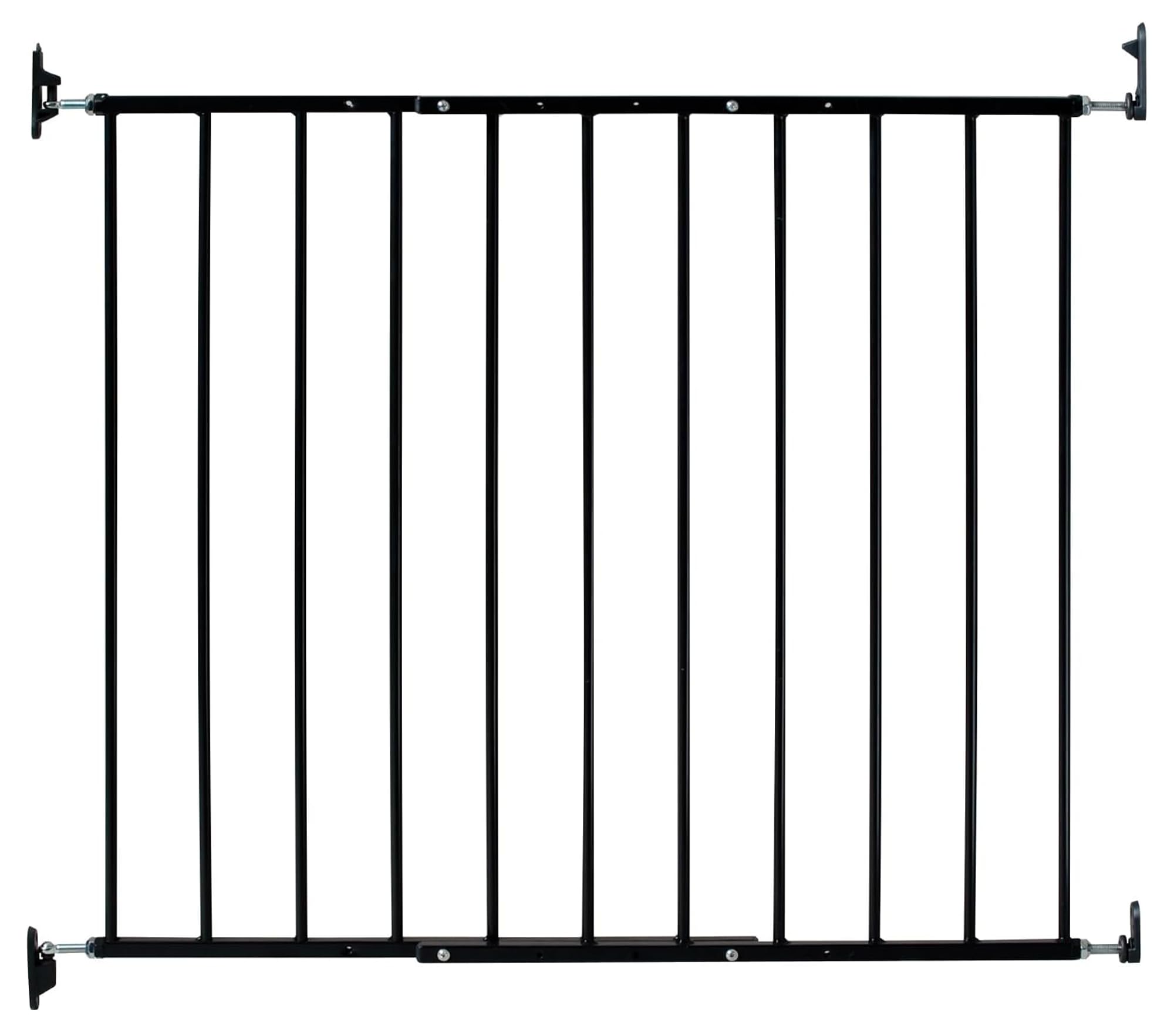
Without a threshold to step over, the gate sits flush with the landing floor, and the stop pin prevents the door from swinging outward over the stairwell — a critical detail that pressure-mounted gates cannot replicate. The frame is all steel, and the quick-release hardware allows you to lift the whole gate out of the brackets when you need clear passage for furniture or a cleaning run.
The mounting system uses four wall plates that screw directly into studs or drywall anchors, and the gate itself clips into those plates without any wobble. Users consistently report that the 30.5-inch height is enough to deter climbing toddlers, and the walk-through door swings fully open without a narrow choke point. The one complaint that surfaces multiple times is the plastic mounting bracket — a few customers note that the bracket can crack after several months of heavy use, though KidCo’s lifetime warranty covers replacement parts.
This gate is not adjustable for uneven banisters out of the box; KidCo sells a separate Universal Installation Kit for non-flat surfaces. If your stair posts are straight and you want a hardware-mounted gate that has no bottom bar and a proven safety record, this is the unit to beat.
Why it’s great
- No bottom bar eliminates tripping hazard at the top of the stairs
- Stop pin prevents dangerous outward swing over the stairwell
- Quick-release removal without tools for easy cleaning
Good to know
- Mounting brackets are plastic and can crack under heavy use
- Does not work on banisters without the separate adapter kit
- Assembly requires careful alignment of wall plates
2. Babelio Removable & No Bottom Bar Baby Gate (R30 Flex Pro)

The Babelio R30 Flex Pro splits into three sections — two vertical bars and the door frame — which means you install the mounting brackets once and lift the entire gate out for storage when the grandkids leave. The no-bottom-bar design is identical in principle to the KidCo, but Babelio adds plastic pads that fit over baseboard trim, so the gate sits flat against the wall even in doorways with thick molding. The dual-lock mechanism requires both a lever pull and a lift, and the auto-close uses a spring hinge that slows the swing rather than slamming it shut.
Installation is straightforward for anyone comfortable with a drill and a level. The kit includes screws and wall plugs, and the full steel construction supports the weight of a 60-pound dog leaning against the panel without flexing. One area where the Babelio stands out is the one-hand operation: the latch is smooth enough that a caregiver carrying a baby can open it without adjusting their grip, yet the spring tension makes it impossible for a child under three to work.
A minor downside appears in the auto-close adjustment. If the gate is not installed perfectly level, the door may require an extra push to fully latch. The instructions are clear, but getting the wall cups aligned to the same vertical plane takes patience. Once set, the gate stays in place and the removable frame makes seasonal use genuinely practical.
Why it’s great
- Three-part removable design stores flat when not in use
- Plastic trim pads fit over baseboards for a flush mount
- Steel frame holds firm under dog and toddler pressure
Good to know
- Auto-close may need manual assist if gate is not perfectly level
- Installation requires precise alignment of top and bottom brackets
- Unlatching sometimes requires two hands to release both locks
3. Babelio 29.7-46.5″ No Bottom Bar Baby/Dog Gate (CB-M-101)

The second Babelio entry in this list expands to 46.5 inches, making it a strong candidate for wide stair landings or open-concept doorways where a standard 38-inch gate leaves a gap. The frame uses alloy steel with a double-button locking system instead of a lever-and-lift, and the door swings both directions — a feature that simplifies traffic flow in a hallway that connects to a landing on one side and a bedroom on the other. The no-bottom-bar design is the same flush-to-floor profile, and the gate comes with a paper template and Allen key for width adjustment.
Customers consistently describe this gate as sturdier than expected for its weight, and the dual-lock mechanism is noted for being secure without being finicky. The walk-through width is the full opening, which means no narrow internal gate within a gate — you step through the same gap that the gate closes. This is particularly useful for a caregiver carrying a laundry basket or a baby in a carrier, because there is no bottleneck at the latch side.
The main trade-off is the height: at 28 inches, it is two inches shorter than the KidCo and the Flex Pro. For most toddlers, 28 inches is still a barrier, but a tall two-year-old with climbing motivation might be able to hook an elbow over the top. The screws included in the package have also been reported as brittle — a few users snapped them during installation and had to substitute their own hardware.
Why it’s great
- Expands up to 46.5 inches for wide landings and doorways
- Door swings both ways for flexible traffic flow
- Full-width walk-through without a bottleneck on the latch side
Good to know
- Only 28 inches tall — climbed by some older toddlers
- Included screws are prone to snapping during install
- Wall hangers must be installed on the same vertical plane
4. Mumeasy Baby Gate Extra Wide (BG-01)
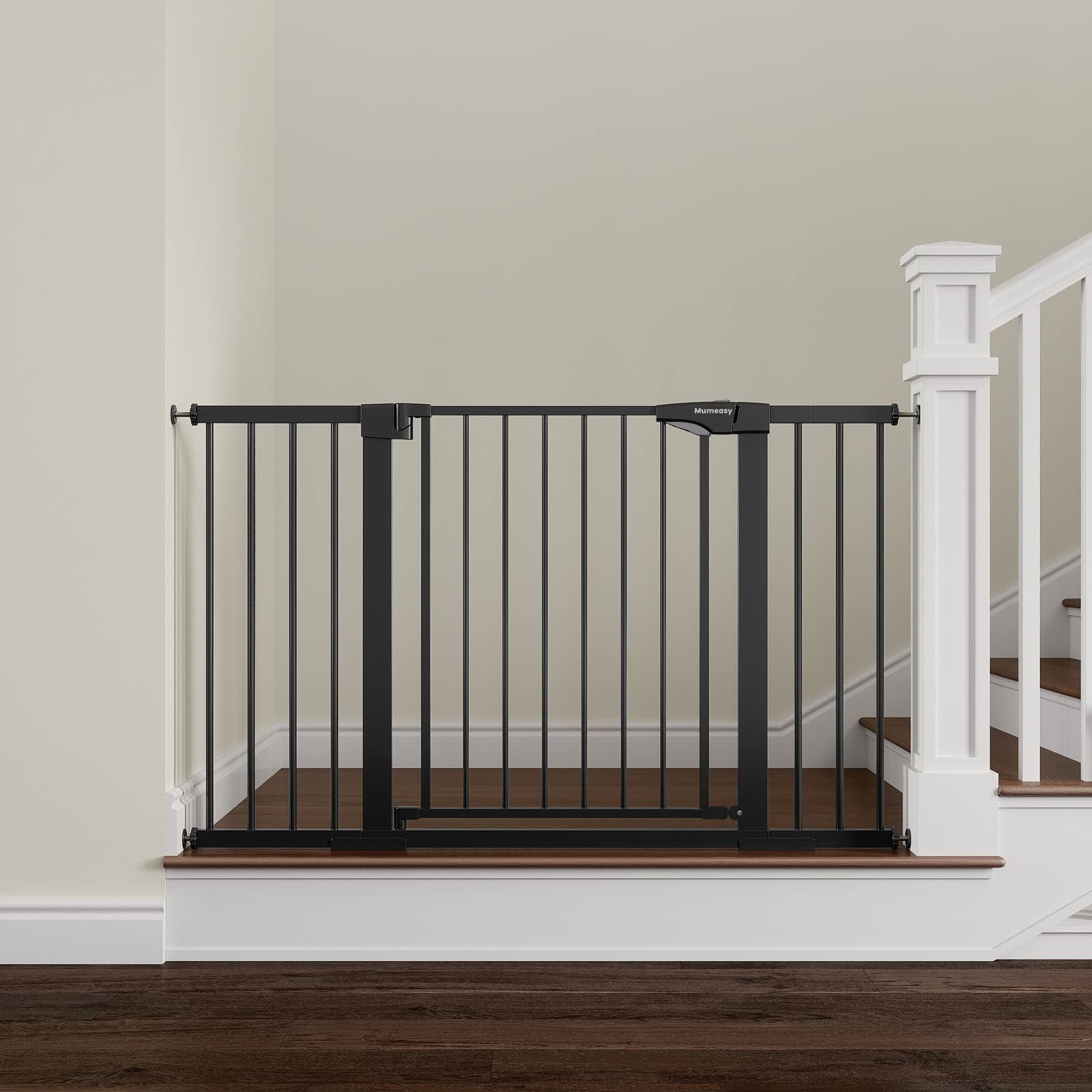
The Mumeasy BG-01 bridges the pressure-mount and hardware-mount worlds by offering both installation methods in one package, but the real story is the width. At 51 inches, it is the second-widest gate on this list, and the included extension kit allows you to hit that maximum without buying separate parts. The 30-inch height is adequate for most toddlers, and the bar spacing of 2.24 inches prevents a puppy’s head from slipping through — a detail that matters if you are also containing a small dog.
This gate earned a Mom’s Choice Award, and the build quality backs it up. The metal frame has a powder-coat finish that resists scratches from daily latch engagement, and the dual-action handle requires a simultaneous pull and lift that adults can do one-handed but children cannot replicate. The auto-close spring is tuned to shut the door softly at any angle less than 90 degrees, and it holds open past 90 degrees when you push it all the way back.
The limitation for top-of-stair use is that the pressure-mount option is not suitable for stair landings. If you choose to hardware-mount this gate, you need to drill into studs or use the included wall cups, and the process takes longer than the dedicated hardware gates from KidCo or Babelio. The three-year warranty is generous and the support team responds quickly, but the dual-mount design makes this a better fit for wide hallways than for a narrow stairwell.
Why it’s great
- Expands to 51 inches with included extension kit
- Dual-action handle is toddler-proof but adult-friendly
- Three-year warranty and responsive customer support
Good to know
- Pressure mount not secure enough for top-of-stair installation
- Hardware mounting process is more involved than dedicated mount gates
- Heavier than most hardware-only gates at over 15 pounds
5. GROWNSY Baby Gate for Stairs (GRYG33)

The GROWNSY gate introduces a visible pressure indicator — a red mark on the locking knob that appears when the tension loosens — which addresses the biggest weakness of pressure-mounted gates: they shift over time. If the red mark is visible, the screws need tightening. This is a genuinely useful feedback system for a device that sits at the top of the stairs, where a loose gate is a fall hazard. The gate also includes a flat anti-stumble pedal that sits flush against the floor, reducing the same tripping risk that the no-bottom-bar gates eliminate, but without requiring hardware installation.
The frame is all metal, and the V-shaped rods are designed for banister mounting. In practice, these rods work well on straight posts but are unstable on rounded or decorative wood banisters — one user report describes the assembly as rickety on non-flat surfaces. The double-locking system requires a lever pull and a lift, similar to the Babelio, and the auto-close engages when the door is opened less than 90 degrees.
This gate fits openings from 29.5 to 48.4 inches, and the 30-inch height matches the KidCo. For a pressure-mounted option, the visible security check is unique, and the pedal design does reduce the trip hazard that conventional pressure gates introduce. The main reason this gate sits lower in the ranking is that pressure mounting, even with an indicator, does not match the rigidity of hardware-mounted alternatives for stair-top use.
Why it’s great
- Visible red indicator shows when tension needs adjustment
- Flat anti-stumble pedal reduces tripping hazard at the base
- Double-locking system is secure for stair placement
Good to know
- V-shaped rods are unstable on curved or decorative banisters
- Pressure mounting, even with indicator, is less secure than hardware
- Some toddlers can manipulate the lock after observation
6. keny 29.7″-46″ Baby Gate for Stairs
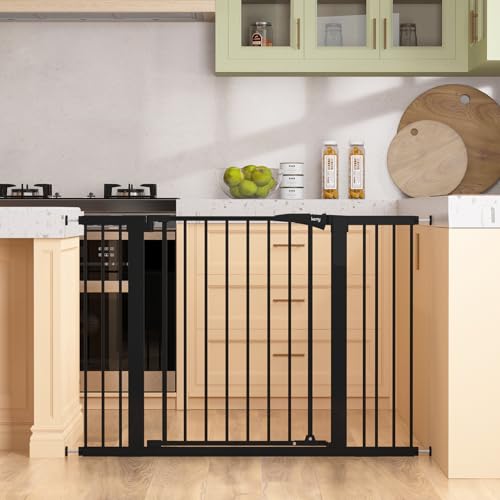
The keny gate is a straightforward pressure-mounted design aimed at buyers who need a functional barrier for doorways and hallways at an accessible price point. The frame is metal, the auto-close works on a spring hinge when the door is opened less than 90 degrees, and the dual-lock mechanism is a simple lift-to-release that adults can operate one-handed. The gate expands from 29.7 to 46 inches and stands 30 inches tall, matching the dimensions of much pricier rivals.
Customer feedback is consistently positive about the ease of assembly and the stability of the pressure mount on standard door frames. The 15-pound weight gives the gate a solid feel, and the all-metal construction avoids the flex that plastic panels introduce. For a downstairs doorway where you need to keep a toddler out of the kitchen, this gate works fine. Several reviews mention that the latch is easy enough for a two-year-old to figure out, which compromises its value as a stair-top barrier.
The limitation is clear: for top-of-stair installation, a pressure-mounted gate without a bottom bar and without hardware anchors is not a safe choice. The keny gate is a solid entry-level product for flat-floor use, but it belongs in the bottom of this ranking because stair safety demands rigid anchoring.
Why it’s great
- All-metal construction at an accessible price point
- Auto-close spring hinge works reliably on flat door frames
- Easy tool-free installation for doorways and hallways
Good to know
- Pressure mount is not secure enough for stair-top use
- Latch mechanism can be manipulated by toddlers
- Lacks a no-bottom-bar design — tripping hazard on landings
7. Cumbor 30-54″ Extra Wide Baby Gate (S7V2)
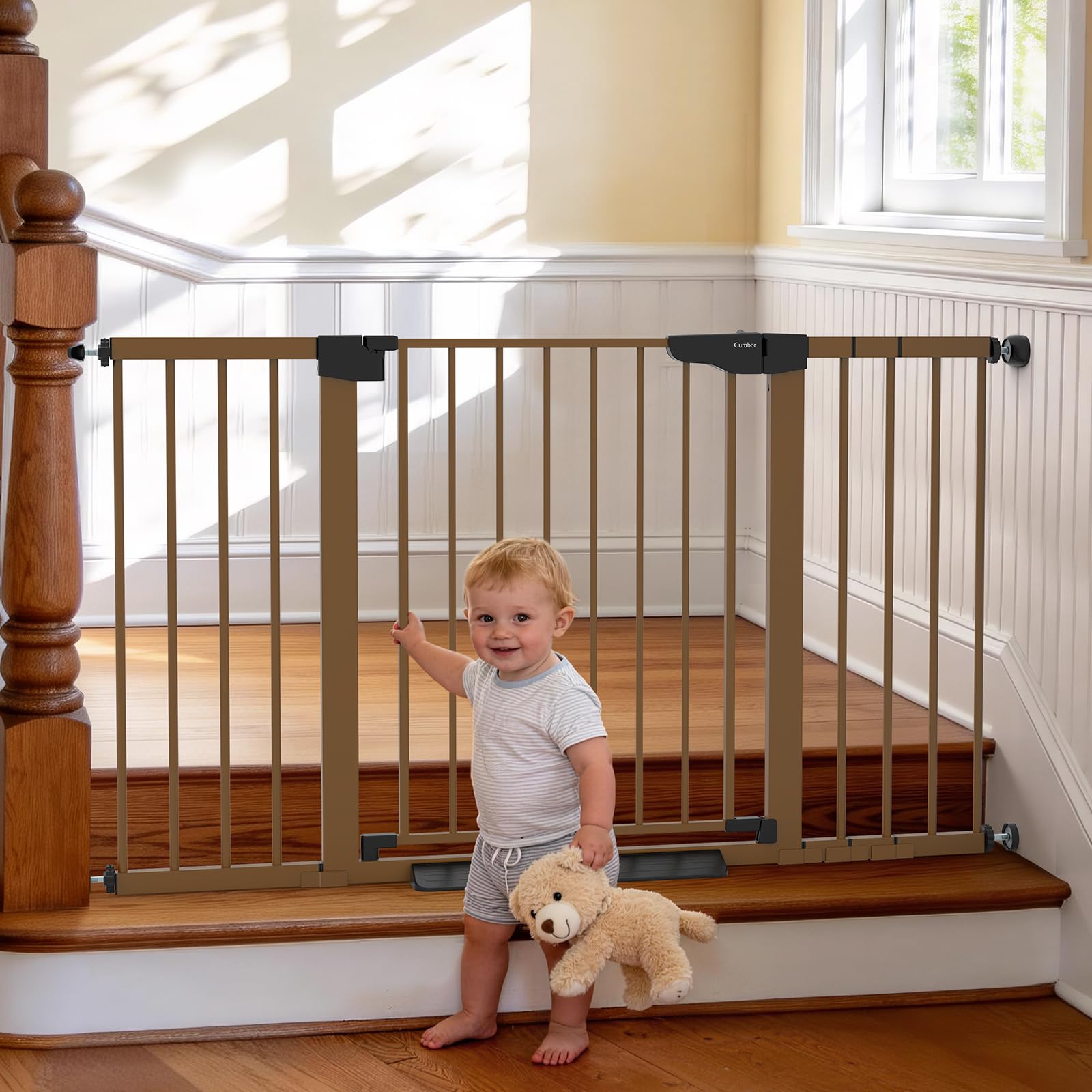
The Cumbor S7V2 is the widest gate on this list, extending to 54 inches, and it supports both pressure and hardware mounting. The frame is carbon steel with a brown finish that blends into wood trim, and the included step-over ramp adds a raised bar across the bottom — a feature that contradicts the no-bottom-bar philosophy of the higher-ranked gates. The ramp is intended to make stepping over easier, but on a stair landing, any raised threshold introduces a tripping hazard.
The dual-lock mechanism uses an auto-close spring and a double-action latch that requires both a pull and a lift. The walk-through door swings both ways and stays open when pushed past 90 degrees. The bar spacing is narrow enough to contain a small puppy, and the 30.5-inch height is competitive with the top options. Users praise the gate for its sturdy feel and the included banister hardware that allows installation on posts without drilling into the baluster itself.
The Cumbor lands at the bottom of this ranking for two reasons: the step-over ramp is a regression in stair-top safety, and the dual-mount system, while flexible, does not match the pure hardware focus of the KidCo or Babelio gates. For a very wide opening at the bottom of the stairs or in a hallway, it is a capable gate. For the top of the stairs, the ramp disqualifies it.
Why it’s great
- Reaches 54 inches for the widest stair landings and doorways
- Includes banister hardware for post mounting without drilling
- Carbon steel frame is sturdy and resists flex under pressure
Good to know
- Step-over ramp creates a tripping hazard on stair landings
- Installation instructions can confuse top vs bottom bracket order
- Dual-mount design is less secure than dedicated hardware mount
FAQ
Can I use a pressure-mounted gate at the top of the stairs?
Why is a bottom bar dangerous on a stair gate?
How do I install a gate on a banister or round post?
What is the minimum height for a stair gate to stop a climber?
Final Thoughts: The Verdict
For most users, the best baby gate for stairs winner is the KidCo Safeway because it combines a hardware-mounted no-bottom-bar design with a 30.5-inch height and a stop pin that prevents outward swing over the stairwell, backed by a lifetime warranty. If you want a removable gate that stores flat when the grandkids leave, grab the Babelio R30 Flex Pro. And for a very wide opening up to 51 inches with a three-year warranty, nothing beats the Mumeasy BG-01.