
Our readers keep the lights on and the weekend projects moving. As an Amazon Associate, I earn from qualifying purchases.
AM radio is the last link to local news, sports play-by-play, and emergency broadcasts when cell towers go dark. But the biggest frustration is the wall of static, frequency drift, and weak signal pull that makes most radios useless after a few miles from the transmitter.
I’m Rikta — the co-founder and writer behind FitlyFast. I’ve spent the last 15 years analyzing category-specific hardware specs, from DSP chip sensitivity to antenna design, so you get a radio that actually locks onto stations.
Whether you need a rugged emergency companion, a desktop retro piece, or a pocketable traveler, the best am radio is the one that combines sensitivity, clear audio, and reliable tuning in the form factor you actually use.
How To Choose The Best AM Radio
Picking an AM radio is less about brand names and more about how a handful of technical choices interact with your listening location. Below are the critical factors that separate a static-filled box from a station-locking receiver.
Reception Technology: DSP vs. Analog
A Digital Signal Processing (DSP) chip actively filters out interference and holds onto a weak signal without you having to constantly tweak the tuning knob. Pure analog circuits are simpler and cheaper, but they drift with temperature and humidity. For serious AM listening or any emergency scenario, a DSP-based radio is non-negotiable.
Antenna Design: Length Matters
AM reception relies on a ferrite bar antenna inside the chassis. While you can’t see the bar, the radio’s ability to pull in distant stations depends on its quality and the circuit that drives it. External telescopic antennas primarily help FM and shortwave. For AM, look for radios that reviewers confirm “pull in stations even in a basement” — that’s the real-world test of the internal ferrite system.
Power Source and Portability
If the radio sits on a desk, AC power and a large speaker matter. If it rides in a bag, battery capacity, weight, and a headphone jack dominate. Emergency radios that combine hand crank, solar, and USB charging add survival utility but may compromise audio quality due to smaller speakers and plastic enclosures. Match the power system to the radio’s primary location.
Quick Comparison
On smaller screens, swipe sideways to see the full table.
| Model | Category | Best For | Key Spec | Amazon |
|---|---|---|---|---|
| Tecsun PL330 | Worldband | DXing & SSB listening | SSB + 850 memories | Amazon |
| Sangean HDR-14 | HD Radio | Digital HD AM/FM clarity | HD Radio + 40 presets | Amazon |
| Audiocrazy Vintage | Retro | Home decor & ambient listening | 10W speaker + Bass Control | Amazon |
| Jazmm Pocket | Compact | On-the-go AM/FM/SW | 1250mAh + weather alert | Amazon |
| Yewrich Retro | Tabletop | Senior-friendly large controls | 5W speaker + 39-inch antenna | Amazon |
| Emgykit R11 | Emergency | Power outages & camping | 4000mAh + solar/crank | Amazon |
| Mesqool Emergency | Survival | Off-grid & long-term emergency | 12000mAh + fast solar charging | Amazon |
In‑Depth Reviews
1. Tecsun PL330 Digital Worldband Radio

The Tecsun PL330 is a serious performer for anyone who wants to explore beyond local AM talk radio. Its DSP-based digital demodulation delivers exceptional sensitivity and selectivity, especially on AM and shortwave bands, where other portable radios fall into a soup of interference. The synchronized detection feature further cleans up weak signals, making distant stations intelligible even at dusk when propagation is messy.
Single Side Band (SSB) reception is included, a rarity at this level, allowing you to tune into amateur radio operators, maritime communications, and utility stations. The 850 memory presets let you store and recall stations without re-tuning, and the sleep timer and alarm clock add everyday utility. At only 7.4 ounces, it’s genuinely pocketable, yet the speaker delivers usable audio for casual listening.
The tuning knob has a detented feel that mutes the audio every 1 kHz during adjustment, which some users find clunky compared to smooth analog tuning. There is no kickstand, so it lies flat on a table. It also lacks NOAA weather bands and FM RDS, so if those matter to you, look elsewhere. But for pure AM DXing with SSB, this is the top performer.
Why it’s great
- Superb AM sensitivity with DSP and sync detection
- SSB reception for amateur and utility band listening
- Small, light, long battery life (22 hours)
Good to know
- Detented tuning knob mutes audio during adjustment
- No weather band or FM RDS
- No kickstand for upright viewing
2. Sangean HDR-14 HD Radio

If your primary goal is to receive HD Radio broadcasts — which offer crystal-clear digital sound and multicast sub-channels — the Sangean HDR-14 is the reference standard. It locks onto both analog and digital AM/FM signals, and its HD sensitivity is noticeably better than competing models like the HDR-16. That means it will decode a weak digital station where others give up and fall back to noisy analog.
The form factor is compact and travel-optimized at roughly 5 inches wide, weighing under a pound. It runs on batteries or the included AC adapter, and the battery life is excellent for a digital radio. The LCD display shows program-associated data (song titles, station info), and it supports the Emergency Alert System for automatic weather-related messaging.
Where it falls short is audio quality. The built-in speaker is adequate for talk radio but lacks bass and clarity for music. Headphone output is also average. The user interface takes some getting used to, with multiple preset pages and a menu system that isn’t entirely intuitive at first. There is no Bluetooth, no auxiliary input, and no shortwave support. It’s a pure HD/FM/AM radio with a narrow mission that it executes very well.
Why it’s great
- Superior HD Radio sensitivity for weak digital signals
- Emergency alert system support built in
- Compact, portable with great battery life
Good to know
- Speaker sounds tinny; best with headphones
3. Audiocrazy Vintage Wooden AM/FM Radio

For the listener who wants their AM radio to double as a piece of furniture, the Audiocrazy Vintage delivers the warmest look and sound of this list. The real wood grain cabinet and softly glowing tuning dial evoke a mid-century aesthetic that blends with leather sofas and wooden bookshelves. But it’s not just a prop — the DSP chip inside provides genuinely solid AM and FM reception that pulls in talk and sports stations without drift.
The audio is where this radio separates itself from the plastic crowd. A 10-watt full-range speaker with a bass compensation circuit fills a small room with rich, clear sound that does not distort at moderate volumes. The separate bass control knob lets you tailor the low-end for music, something no other radio here offers. Bluetooth 5.0 streaming and an auxiliary input mean it pulls double duty as a speaker system when you’ve had enough talk radio.
This is an AC-powered unit only — there is no battery option, so it stays put on a counter or shelf. At higher volume levels, the speaker begins to distort, so it’s better suited for near-field listening in a kitchen or office than for a party. The vernier tuning dial is a classic mechanism that may feel looser than a digital button, but it adds to the tactile charm if you grew up with analog radios.
Why it’s great
- Genuine wood cabinet and glowing dial for retro decor
- 10W speaker with bass control provides rich audio
- Bluetooth 5.0 and AUX for modern streaming
Good to know
- AC only — no battery power for portability
- Speaker distorts at maximum volume
4. Jazmm Bluetooth AM/FM/SW Pocket Radio

The Jazmm pocket radio packs an absurd number of features into a chassis that fits in a palm. AM, FM, shortwave, and NOAA weather bands are all covered, and the advanced DSP chip keeps reception stable enough that even users in known dead zones report pulling in stations that other pocket radios miss. The 1250mAh rechargeable battery provides 10-12 hours of playback via USB-C, and the included flashlight adds genuine emergency value.
Sound quality is surprisingly full for the dimensions thanks to a 5W speaker that fills a small room without distortion. The Bluetooth 5.4 connectivity and TF card slot mean it functions as a portable speaker and MP3 player when you’re not tuning the airwaves. The back clip and wrist strap make it genuinely wearable for walks, bike rides, or construction site use. Reviewers consistently praise the clear display and simple button layout.
The AM band does exhibit some internal noise that can mask very weak stations. The shortwave band would benefit from an external antenna, but that’s true of any pocket shortwave receiver. The speaker lacks bass extension, so music sounds thin compared to larger radios. This is a compromise you accept for something that disappears into a jacket pocket.
Why it’s great
- Pocket-size with AM/FM/SW/NOAA bands
- USB-C rechargeable with 10-12 hours run time
- Bluetooth 5.4, TF card, and flashlight included
Good to know
- AM band has minor internal noise on weak stations
- Speaker lacks bass; music sounds thin
5. Yewrich Portable AM/FM Shortwave Radio

The Yewrich retro radio stands out for its large, easy-to-grip knobs and clear labeling, making it ideal for older users who find tiny buttons frustrating. The 39-inch telescopic antenna provides strong reception, especially on FM and shortwave bands, and even in rural areas with notoriously poor signal, users report it holding stations without drift — something their previous radios could not manage.
With a 5W speaker in a relatively large plastic cabinet, the sound is fuller than pocket radios but thinner than premium tabletop units. Bluetooth, USB, and TF card playback give it versatility beyond radio. The handle on top makes it easy to carry from room to room or out to the patio. AC power and battery operation (standard cells) mean it works during power outages without needing a rechargeable battery.
Shortwave tuning is a bit fiddly for beginners, as stations below 10 MHz can bleed into one another. The AM reception, while good for the price, can exhibit DSP choppiness when a strong local signal overwhelms the front end. The speaker lacks the loudness and bass needed for music, but for talk radio and baseball games, it is more than sufficient.
Why it’s great
- Oversized knobs and clear display for senior users
- 39-inch antenna provides strong FM/SW reception
- AC or battery power for flexible use
Good to know
- Shortwave tuning bleeds between stations
- AM DSP can chop in strong-signal areas
6. Emgykit R11 Solar Hand Crank Emergency Radio
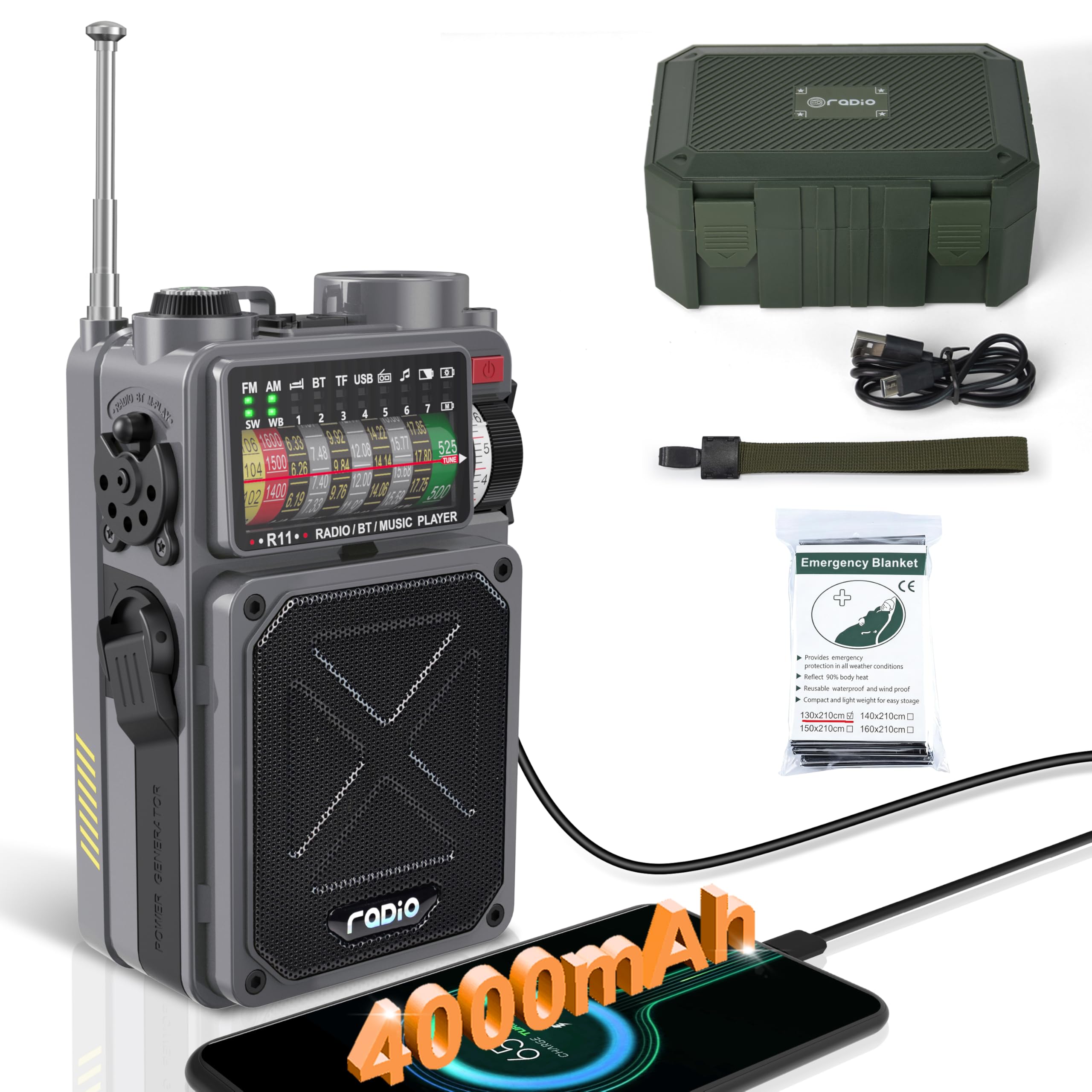
The Emgykit R11 is built for the person who wants one radio that covers AM, FM, NOAA weather, and shortwave while never needing to worry about dead batteries. Its 4000mAh battery provides up to 32 hours of playback on a full charge, and the three power sources — USB-C, hand crank (3 minutes for a quick boost), and an actual working solar panel — mean it stays alive during multi-day power outages or camping trips.
Beyond radio, it includes a 120-lumen flashlight, a compass, an SOS alarm, and a USB port that can charge a phone in a pinch. The integrated white noise generator and sleep timer make it usable as a bedside sound machine. The digital scanning mode automatically stores up to 70 channels per band (210 total), though scanning effectiveness depends on local signal strength. It comes in a foam-padded storage box with a carrying strap.
The speaker is surprisingly robust for a small unit, but audio quality is not its primary mission — clarity for emergency announcements is. The white noise loops are short and loop noticeably, which may annoy some users trying to fall asleep. The unit is slightly heavy at over a pound, so it won’t disappear into a pocket like the Jazmm. The solar panel, while functional, charges slowly in overcast conditions.
Why it’s great
- 4000mAh battery with solar, crank, and USB charging
- AM/FM/NOAA/SW coverage with digital auto scan
- Built-in flashlight, SOS alarm, and phone charger
Good to know
- White noise loops are short and repetitive
- Heavier and bulkier than pocket radios
7. Mesqool Emergency Solar Radio 12000mAh
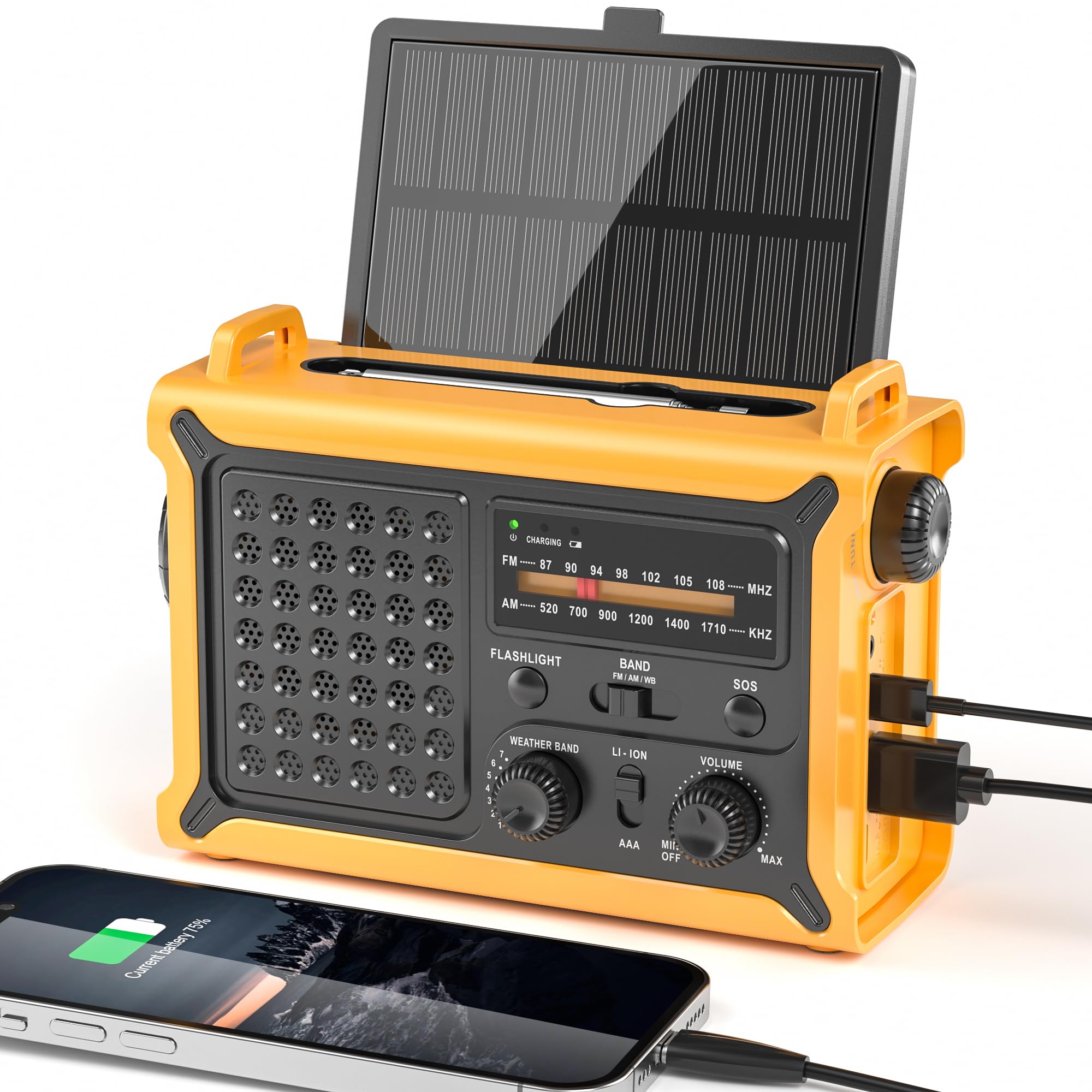
The Mesqool radio is the most serious emergency radio on this list, built around a genuinely high-capacity 12000mAh lithium battery that can keep the radio running for days and still charge your phone. The solar panel is a large 8500mm² monocrystalline unit — about four times the surface area of decorative panels on cheaper radios — which allows meaningful solar charging even in overcast conditions.
Reception is handled by a high-sensitivity DSP chip with noise reduction circuitry and an extended antenna, providing clean AM, FM, and NOAA weather reception. The hand crank mechanism uses an upgraded internal generator with a larger copper coil and stronger magnet, achieving about double the charging efficiency of standard crank radios. Three minutes of cranking provides useful runtime. A powerful LED flashlight (260 feet beam) and a soft reading lamp with two brightness levels each cover both survival and comfort lighting needs.
This radio is physically substantial — billed as “brick-like” by users — and is best left in a go-bag or kitchen window rather than carried on a daily walk. The analog tuning dial and simple controls make it easy to operate under stress, but there is no digital frequency display. The radio can also accept three AAA alkaline cells as a backup. Build quality is rugged ABS plastic with a weather-resistant design, and the yellow color increases visibility in a dark emergency.
Why it’s great
- Massive 12000mAh battery with fast solar charging
- High-efficiency crank generator for quick power-ups
- Rugged build with dual LED lights and weather resistance
Good to know
- No digital frequency display (analog tuning only)
- Bulky and heavy for anything other than emergency storage
FAQ
Why does my AM radio sound fuzzy when I touch the antenna?
Can a long external antenna improve my AM reception?
What is the difference between AM and FM interference?
Do I need a special radio to hear AM stations after sunset?
Final Thoughts: The Verdict
For most users, the best am radio winner is the Tecsun PL330 because it combines class-leading AM sensitivity with SSB reception and a pocketable form factor that serious listeners demand. If you want pure HD Radio clarity for FM and AM digital broadcasts, grab the Sangean HDR-14. And for off-grid emergency preparedness where battery life and multi-source charging define the experience, nothing beats the Mesqool Emergency Solar Radio.