
Our readers keep the lights on and the weekend projects moving. As an Amazon Associate, I earn from qualifying purchases.
Specs are compiled from manufacturer listings and verified buyer reviews and can change over time — please confirm the key details on the product page before buying.
You want the night sky without the setup nightmare — a telescope that finds objects for you instead of forcing you to learn star charts and motorized aiming first. That is exactly the promise of a computerized GoTo mount: it slews to thousands of targets automatically. Our job is to separate the scopes that deliver that promise from the ones that frustrate, and to match each one to the right kind of beginner.
I’m Rikta — the founder and writer behind FitlyFast. This guide is built by comparing the manufacturers’ published specifications and the patterns across verified customer reviews, so you get each pick’s real strengths and trade-offs instead of marketing spin.
Whether you prefer a classic eyepiece or a smart camera that stacks its own photos, the ideal computerized telescope for beginners fits your patience level and your sky conditions.
Our Picks at a Glance

How To Choose Your First Computerized Telescope
Before you pick a brand, decide how you want to see the stars: through a glass eyepiece or on a phone screen. Classic GoTo scopes (telescopes that automatically point at objects you select) let you look directly through the lens. Smart telescopes use a camera sensor to capture images and send them to your phone or tablet. Both are computerized, but they suit very different beginners.
Eyepiece scopes vs. Smart telescopes
Eyepiece scopes like the Celestron models give you the traditional experience — you put your eye to the lens and watch Saturn in real time. Smart scopes like the DWARFLAB and UNISTELLAR models are better for sharing: everyone in the group views the same screen, and the onboard software stacks multiple exposures to reveal faint structure your eye could never see.
Alignment: The make-or-break skill
Every computerized mount needs a rough alignment before it can find objects. Look for SkyAlign-style systems that let you point at any three bright stars or planets without knowing their names. Some smart scopes skip this entirely with automatic plate-solving — they photograph a patch of sky and figure out where they are pointing on their own.
Realistic expectations for your first nights
Many beginners expect Hubble-quality images on night one. With a classic telescope you are working with single frames and your own focusing skills; with a smart scope you need to let it stack frames over several minutes for the best deep-sky results. Budget your expectations, because every option here involves a learning curve of some kind.
Quick Comparison
| Model | Best For | Optics | Focal Length | Viewing Style | Amazon |
|---|---|---|---|---|---|
| DWARF 3★ Best Overall | Portable deep-space imaging | Dual Lens System | Telephoto & Wide-Angle | App / Smart Camera | Amazon |
| NatGeo 70mmBudget Champion | Budget tabletop use | 70mm Refractor | 350mm | Eyepiece | Amazon |
| DWARF MiniCompact Pick | Pocket travel imaging | Sony IMX662 Sensor | 150mm | App / Smart Camera | Amazon |
| Celestron 114LCM | Classic GoTo on a budget | 114mm Reflector | 9mm Eyepiece | Eyepiece | Amazon |
| ZWO Seestar S30 Pro | Urban astrophotography | Dual-Camera 4K | 160mm | App / Smart Camera | Amazon |
| Celestron NexStar 6SE | Light-gathering power | 6″ Schmidt-Cassegrain | 1500mm | Eyepiece | Amazon |
| UNISTELLAR Odyssey | Citizen science | 85mm f/3.9 | 320mm | App Only | Amazon |
| UNISTELLAR Equinox 2 | Deeper light collection | 114mm f/4 | 450mm | App Only | Amazon |
In‑Depth Reviews
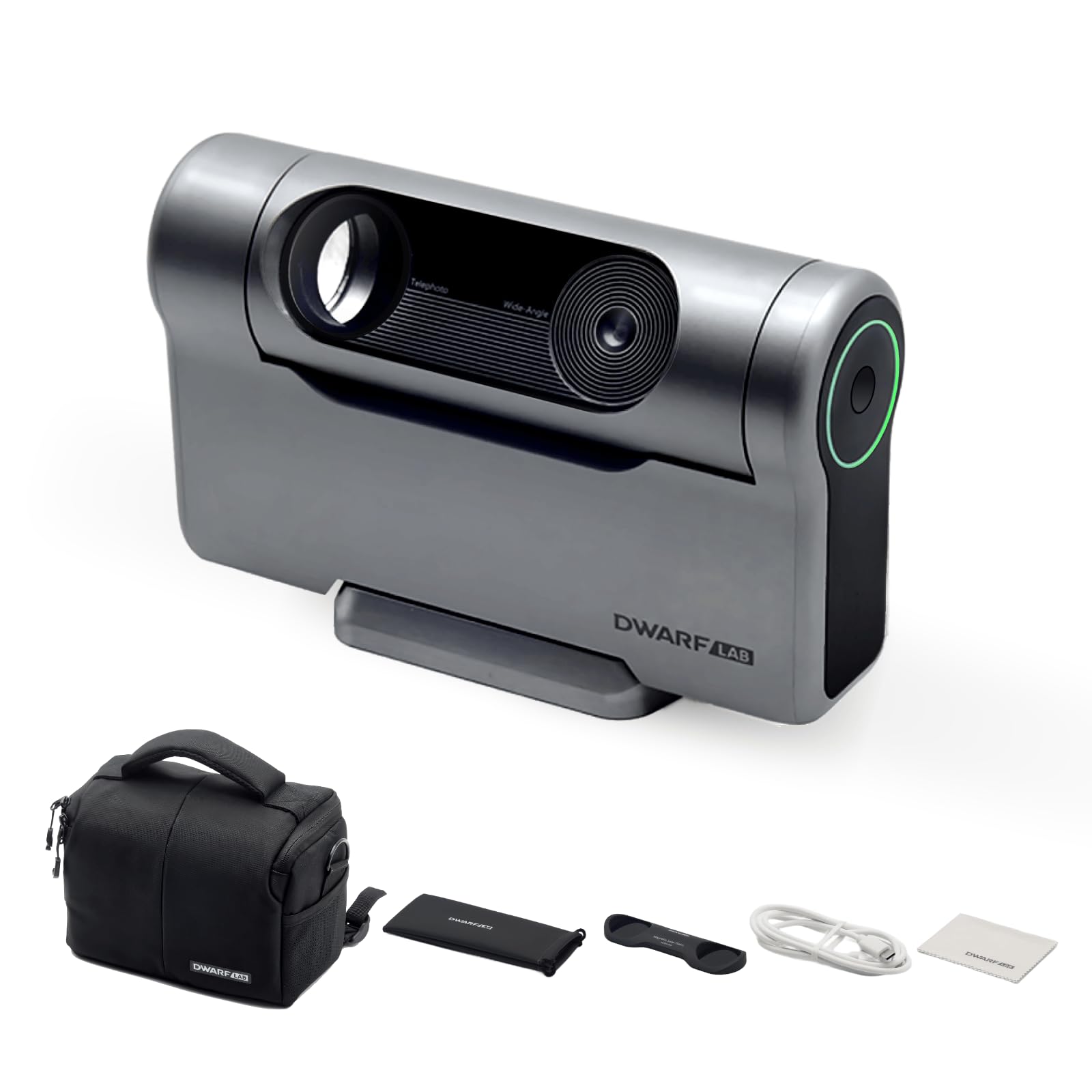
1. DWARFLAB Dwarf 3 Smart Telescope
Our pick — over 4★ from 200+ verified ratings; the strongest balance of quality and price.
A book-thick smart scope that fits a backpack and still captures deep-space color.
This is the pick for beginners who want astrophotography results without learning a single manual technique. The dual-lens system pairs a telephoto for wildlife and deep-sky objects with a wide-angle for Milky Way shots, and the app handles the rest with cloud-powered processing. It weighs just under 3 pounds, so it slips into a standard backpack for trips to darker skies.
The 4K auto-tracking system follows celestial objects on its own, and buyers report excellent results even from light-polluted city backyards. The built-in battery plus a 24000mAh external pack keeps it running all night. Programmable autonomous tracking also lets it capture targets like Markarian’s Chain overnight without supervision.
Compared to the smaller DWARF Mini, this model adds the dual-lens versatility and larger battery capacity that make it the better all-rounder for a family’s first smart scope. The software is the recurring split — for every owner who says the app works like a dream, another finds it non-functional some of the time. As owners put it: “Excellent photos of dim objects despite heavy light pollution.”
Why owners love it
- Build quality wins people over fast, with image quality close behind
- Auto-tracking plus EQ mode handles deep-space targets overnight
- Included solar filter and magnetic filters add daylight and moon uses
The trade-offs to know
- App software earns mixed feedback across the review pages
- One owner notes a single non-removable battery, unlike earlier models
- You will want the optional DWARF tripod for the steadiest tracking
Reach for this if: you want shareable, editable astro photos with minimal learning and maximum portability.
Look elsewhere if: you prefer the traditional eyepiece view and want zero dependence on app software.
2. National Geographic 70mm Refractor Telescope
The lowest-cost doorway into a hand-box GoTo that fits on a desk.
This entry-level refractor lets you try computerized astronomy without committing to a big budget. The wide-field lens and compact tripod mean it can stand on a table or desk, and the hand-box computer handles the alignment math for you. With an 18x – 88x magnification range and 350mm focal length, it is built for quick looks at the Moon and brighter planets rather than faint galaxies.
Its defining advantage is the price of admission — this is the most accessible way to experience a motorized GoTo mount. The included aluminum tripod keeps it stable on flat terrain, and the small design stores easily between trips. Battery-powered operation means you can use it outdoors away from a wall outlet.
The honest picture from owners is mixed. Some find the setup easy and the alignment accurate, while others — as owners mention — spent three weeks unable to make the automatic features function. The operating manual gets called out as sorely lacking even when the assembly guide is fine. This is a pick for tinkerers patient enough to learn its quirks, not for someone expecting flawless out-of-box automation.
Where it delivers
- Entry-level pricing makes GoTo astronomy affordable to try
- Battery-driven hand control works outside without a power cable
- Compact footprint suits a desk, table, or small balcony
The catches
- The operating manual frustrates owners trying to master auto features
- One unit arrived with a faulty focus mechanism from the start
- Hand controller needs a CR1220 battery replaced early to save settings
Pick this if: budget is the priority and you enjoy learning through trial and error.
Think twice if: you want dependable automation without reading between the lines of a weak manual.
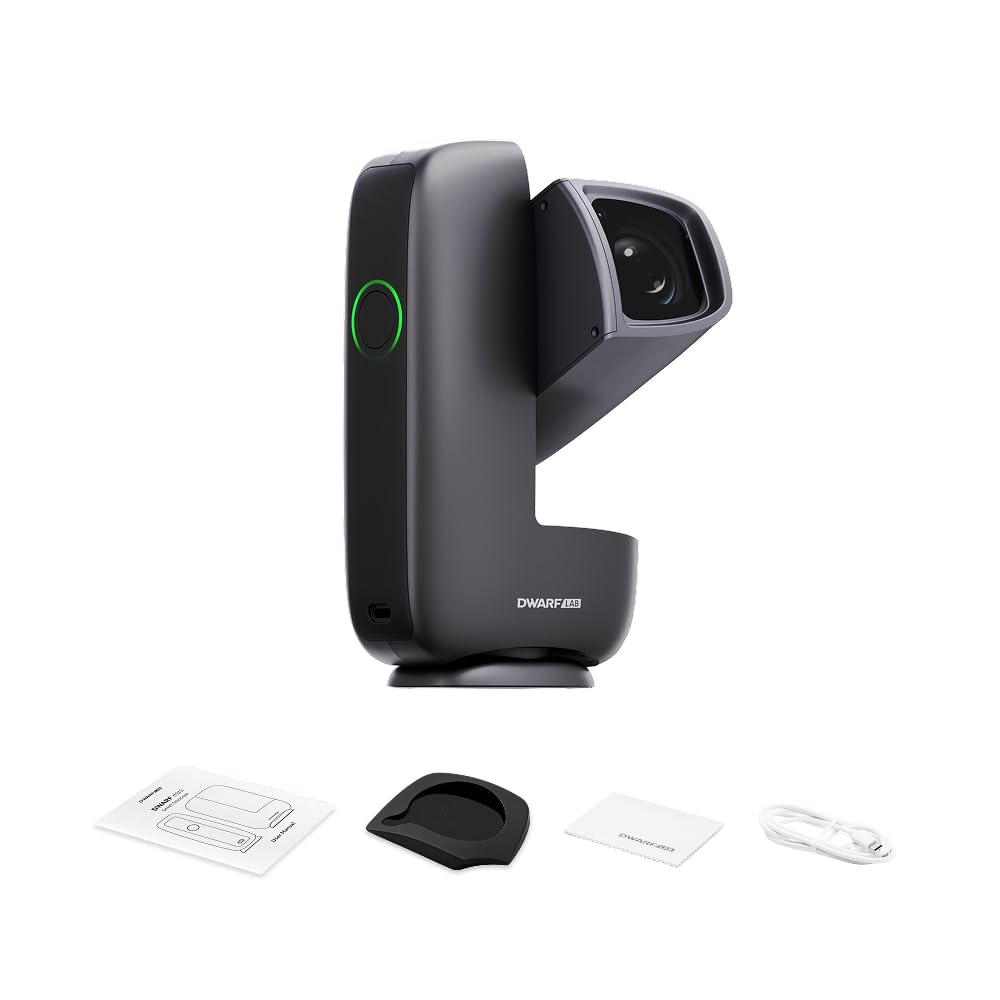
3. DWARFLAB Dwarf Mini Smart Telescope
A 1.85-pound smart scope that rides in a large pocket and tracks deep space.
This is the travel-first version of the DWARFLAB line, built to disappear into a backpack or oversized pocket on the way to a dark-sky site. Its high-sensitivity Sony IMX662 sensor — a 1/2.8-inch chip with 2.9μm pixels — captures low-noise astro detail that brings faint nebulas and star clusters to life. The built-in sky atlas in the app lets you select any target and let the Auto GOTO handle the aiming.
Equatorial Mode open up single-frame exposures up to 90 seconds, and built-in light-pollution filters cut through city glow. Customers note it outperforms a full DSLR on a Celestron 8 SCT for deep-space photography with default settings. The 360° pivot freedom means no blind spots when tracking across the sky.
Unlike the Dwarf 3, this scope uses a single lens with a 150mm focal length (the distance light travels from lens to sensor), so it is not built for planets — Jupiter’s moons show up as dots, and small deep-sky objects look weak. Reviewers point out mixed feelings on the field of view, and the low resolution means you cannot make large prints. It also ships without a carrying case, which several owners call an oversight.
What wins people over: the quality-to-size ratio is the star here — owners are blown away by the images from a unit that costs a fraction of a full imaging rig.
The honest limit: resolution caps out for large prints and small galaxies, and you will want a tripod and power bank for long sessions.
4. Celestron 114LCM Computerized Reflector
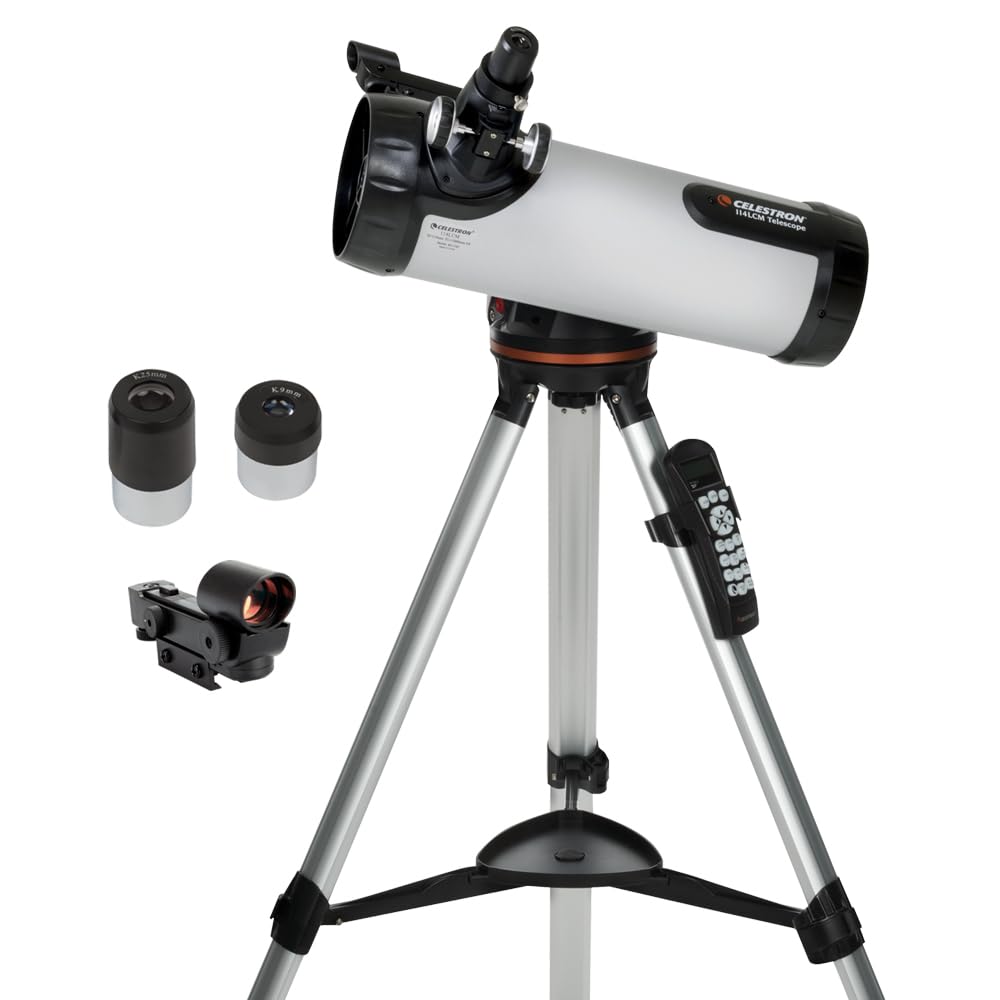
A classic reflector with a database of 4,000 objects and a Sky Tour button.
This is the traditional GoTo experience done affordably. The 114mm Newtonian reflector with all-glass optics pairs with a computerized mount that automatically locates 4,000 celestial objects. Unsure what to look at? Press Sky Tour and the telescope generates a list of the best objects currently visible in your sky — perfect for a family gathering where nobody knows where to point.
Everything needed for a first night ships in the box: a full-height tripod, two eyepieces (25mm and 9mm), and a StarPointer red dot finderscope to help aim. The free Starry Night software download lets you plan observing sessions from any location on Earth. For the price, this is the most complete classic kit in the list.
Owners say the setup is genuinely approachable for beginners, and the automated tracking holds the Moon steady enough to zoom into a single crater. The recurring themes are alignment and durability — get the alignment right and the GoTo works beautifully, but expect a learning curve. The tripod benefits from added weight, and the Bird-Jones optical design limits how far you can push magnified views with extra Barlows.
Strengths that matter
- Sky Tour turns an empty sky into a guided tour for families
- Single-planet alignment takes under two minutes and tracks well
- Complete kit — tripod, two eyepieces, and finder included
What to manage
- Alignment is the most-discussed hurdle across owner feedback
- Stock eyepieces push many buyers toward aftermarket upgrades
- Laser finder can knock out of alignment easily
Who it fits: families and first-timers who want a guided classic telescope with honest limitations.
Who it doesn’t: photographers and observers who want sharp high-power optics from the start.
5. ZWO Seestar S30 Pro Smart Telescope
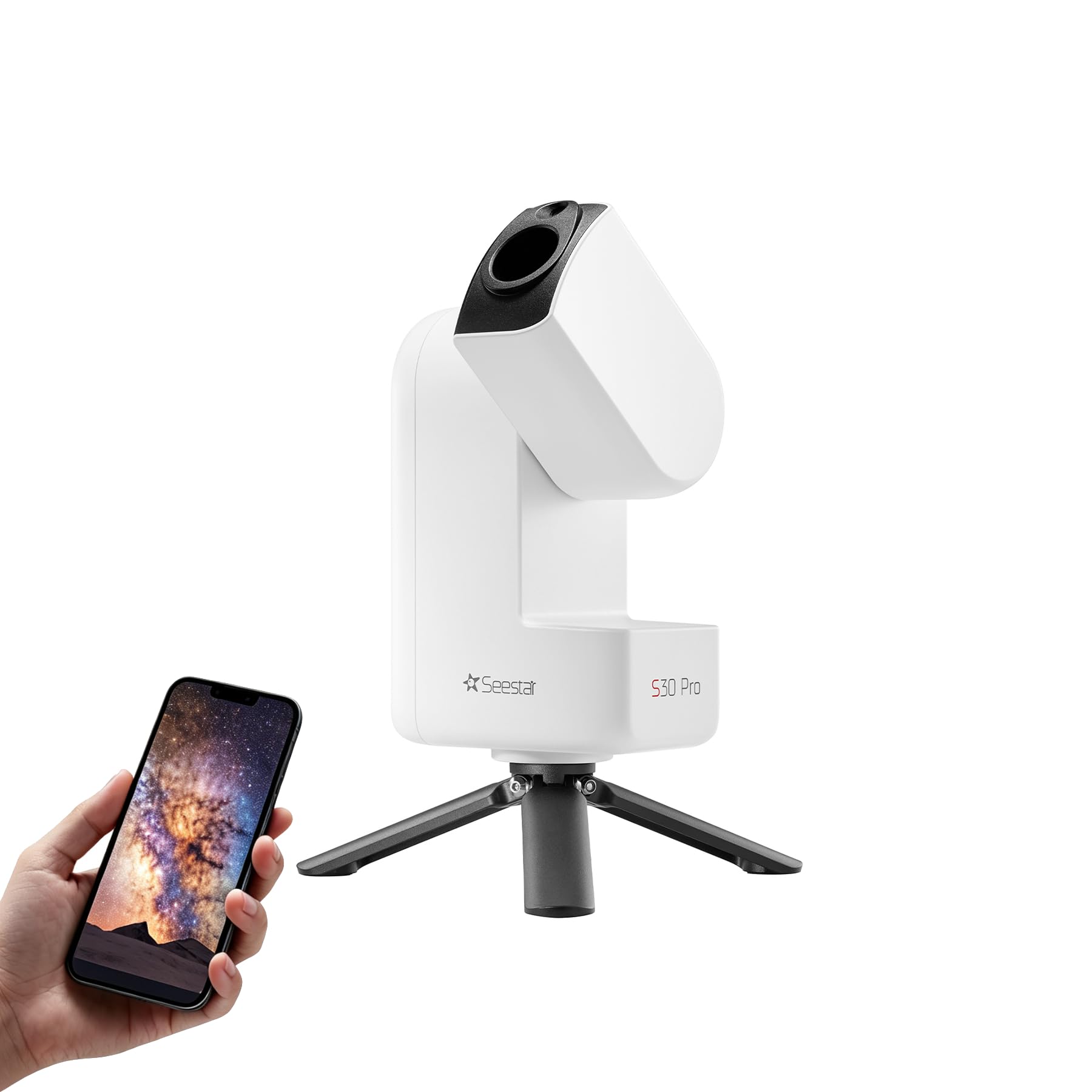
An urban-friendly smart scope that pulls deep-sky detail out of a 3.64-pound frame.
This is the smart scope built for city dwellers. The apochromatic optics reduce color distortion for sharper stars, and built-in light pollution filters help you capture clearer astrophotography even in bright urban environments. Weighing 3.64 pounds with a 160mm focal length, it is small enough to tuck under a car seat yet resolves deep-sky objects with dual-camera 4K imaging.
The defining feature is one-tap imaging. A single tap captures the Milky Way, star trails, planets, or galaxies, with automatic mosaic stitching for wide-field shots and AI noise reduction to clean up the final image. Owners mention 10-minute test shots succeeding from light-polluted cities with cirrus clouds present.
Setup earns near-universal praise — power on, connect the app, and the self-aligning mount handles the rest. The built-in anti-dew protection supports all-night sessions, and plan mode lets you schedule captures while you sleep. The one consistent complaint is the documentation: owners call it good at describing what the scope does but weak on how to do it, with some buying separate books to learn the workflow.
Why it wins in the city
- Built-in light pollution filters make backyard imaging viable
- One-tap Milky Way, star trail, and galaxy modes remove the learning curve
- Fully multi-coated optics produce sharp, high-contrast stars
Plan around these
- Documentation lags behind the hardware’s capabilities
- Keep the device stationary during deep-sky imaging for stable tracking
- Manual controls are limited compared to dedicated astro cameras
Best suited to: beginners and kids in light-polluted areas who want instant, gorgeous deep-sky images.
Consider otherwise if: you prefer hands-on manual control over one-tap automated imaging.
6. Celestron NexStar 6SE Schmidt-Cassegrain

A classic 6-inch light bucket that reveals galaxies and cluster details your eye can see.
This is the serious beginner’s telescope — the one that keeps you growing for years. The 6-inch Schmidt-Cassegrain aperture gathers enough light to reveal fine lunar details, cloud bands on Jupiter, and deep-sky objects like galaxies and globular clusters. With a 1500mm focal length and the same SkyAlign system as its smaller sibling, it pairs real observing power with beginner-friendly automation.
Owners consistently report crisp views of Saturn with its moons and successfully resolving objects like M51, M81/82, and M3. The portability is a genuine strength — one owner notes it fits in a MINI’s boot, making it a grab-and-go scope that travels to darker skies. The GoTo accuracy earns repeated praise, with the mount holding targets steadily once pointed.
The recurring advice from owners is to budget for companions: a dew shield to prevent moisture buildup on the corrector plate, a power bank since batteries drain quickly, and better eyepieces than the stock 25mm. The mount quality draws mixed feedback around stability, and the included bubble level is called near-useless. For the money, though, owners repeatedly call it a fantastic first telescope with sharp optics and reliable GoTo.
The payoff
- 6-inch aperture pulls in galaxies and globular clusters reliably
- GoTo accuracy earns repeated owner praise
- Compact single-fork design travels easily
The prep work
- A dew shield and power bank are practical must-haves
- Stock eyepieces are mediocre — plan upgrades
- Mount stability and alignment draw mixed reviews
Who it rewards: beginners who want lasting light-gathering power and are ready to invest in a few key accessories.
Who it frustrates: buyers expecting a flawless all-in-one kit with no add-on purchases.
7. UNISTELLAR Odyssey Smart Telescope

A 5-hour battery and NASA-backed citizen science that turns your backyard into a lab.
This is the flagship app-only scope — there is no eyepiece, just a 33.6 × 45 arcmin field of view displayed on your phone or tablet. With an 85mm f/3.9 mirror and 320mm focal length, it starts observing in under two minutes: power on, connect, and the motorized Alt-Az mount does automatic alignment and one-click GoTo. No polar alignment, no calibration, no star charts.
What makes the Odyssey unique is the citizen-science angle. It taps into a 5,000+ object catalog with a 37-million-star database, and you can join NASA & SETI campaigns for asteroid occultations and exoplanet transits. That turns a casual hobby into a way to contribute to real discovery. The 64GB onboard storage and RAW/FITS export give you professional-grade data to process later.
Owners are nearly unanimous on the core experience: “Super easy to use,” with gorgeous images of the Moon, Saturn, Jupiter, and galaxies arriving quickly — some deep-sky objects capture in about five minutes. The trade-offs are the premium price and the missing manual control; the app is basic, cloudy-sky orientation can fail, and there is no daytime use or dew heater. The 5-hour battery is generous but the scope expects you to keep the app experience at its center.
The defining strength: ease of use outclasses everything else here — the review pages read like a chorus of “plug and play” and “my kids love it.”
The setup’s limit: you trade away manual control, wide-view camera options, and a dew heater for that simplicity, at a premium price.
8. UNISTELLAR Equinox 2 Smart Telescope
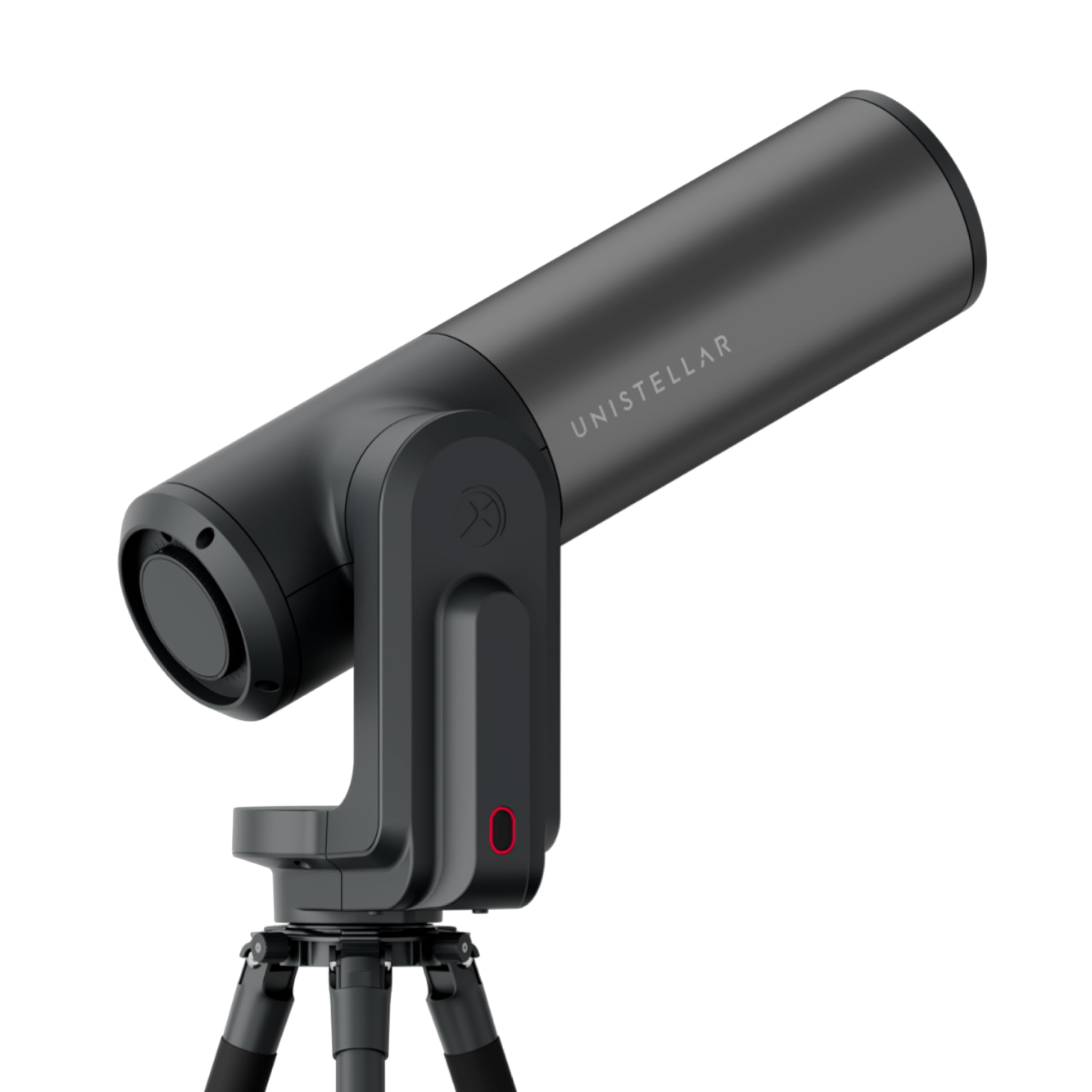
The largest aperture in this list, built to reach deeper galaxies and richer planet detail.
This is the larger model in UNISTELLAR’s range, and its 114mm f/4 aperture (the lens opening that gathers light) with a 450mm focal length reaches a limiting magnitude around 18.2 — that is the faintest star it can detect, enough for deeper galaxies, nebulae, and more planetary detail than any other smart scope in this list. The field of view covers 34.2 × 45.6 arcmin (a measure of sky area), and the included tripod plus 11-hour battery make it a serious all-night instrument.
The feature set mirrors the Odyssey: motorized Alt-Az mount, one-click GoTo, 64GB storage, RAW/FITS export, and the same 5,000+ object catalog with NASA & SETI citizen-science compatibility. The manual fine-focus control gives you a sharpness option the Odyssey lacks, which matters for planetary work where precise focus is everything.
The review sentiment here is the hardest split in this list. Some owners capture nice photos of several deep-sky objects within 45 minutes of setup and call it easy. Others report alignment failures over multiple nights, double images from misaligned mirrors, and a battery replacement concern, with a couple of tech-savvy owners unable to operate it at all. The premium price makes these failures feel magnified.
The bold promise: the deepest light collection of any pick here, ideal for faint galaxies and rich planet detail on clear nights.
The honest warning: this is the most divisive scope in the roundup — know your troubleshooting tolerance before spending at this level.
Understanding the Specs
Aperture and light gathering
Aperture is the diameter of the main mirror or lens, and it is the single most important spec for what you can see. Bigger apertures collect more light, which reveals fainter galaxies and nebulas. In this list, apertures range from 70mm on the budget refractor up to 114mm on the Equinox 2 — the 6-inch Celestron is the classic choice for serious light gathering.
Focal length and magnification
Focal length determines your magnification and field of view. Longer focal lengths like the NexStar 4SE’s 1325mm give high-power views of planets and the Moon, while shorter focal lengths like the Dwarf Mini’s 150mm offer wider fields for deep-sky imaging. Longer scopes are sharper on planets; shorter scopes capture more sky in one frame.
FAQ
What is the difference between a Smart telescope and a classic GoTo telescope?
How hard is alignment for a beginner?
Can I see planets with an app-only smart telescope?
Do I need a tripod and power bank for a smart telescope?
Will a computerized telescope work in a city with light pollution?
What is the difference between Equatorial and Alt-Az mounts?
How many objects can a computerized telescope find?
Is a smart telescope better for kids than a classic one?
Which telescope is better: smart camera or classic eyepiece?
Why do some computerized telescopes have lower ratings than others?
Final Thoughts: The Verdict
For most beginners, the computerized telescope for beginners winner is the DWARFLAB Dwarf 3 — it packs portability, dual-lens versatility, and real deep-space imaging into a scope that fits in a backpack. If you prefer a classic eyepiece experience that grows with your skills, choose the Celestron NexStar 6SE. And for city dwellers who want one-tap astrophotography, the ZWO Seestar S30 Pro is the crowd favorite — thousands of owners back its easy path into the night sky.
How We Picked
We do not accept paid placement. Every pick is matched to a real buyer and a real use-case; we do not hands-on test units.
Sources & Methodology
Specifications: manufacturer listings and product documentation. Review insights: verified customer reviews, as of August 2026. Pricing: not shown on this page (it changes often); check the current price via the retailer link.
As an Amazon Associate, FitlyFast earns from qualifying purchases. This does not affect which products we feature.