
Our readers keep the lights on and the weekend projects moving. As an Amazon Associate, I earn from qualifying purchases.
A loud, rattling air compressor can turn a focused workshop session into a headache-inducing chore. The real decision isn’t just about PSI or tank size — it’s about finding a unit that delivers steady, reliable power without forcing you to shout over it. Whether you’re finishing trim, inflating tires, or running a spray gun, the right compressor lives in the background, not on your nerves.
I’m Rikta — the co-founder and writer behind FitlyFast. I’ve spent dozens of hours analyzing pump designs, noise ratings, and real-world CFM delivery across dozens of models to separate the genuinely quiet workhorses from the marketing claims.
This guide cuts through the spec sheets to help you buy with confidence, comparing noise levels, duty cycles, and portability to find the best air compressor for your specific projects.
How To Choose The Best Air Compressor
Choosing an air compressor means matching three core specs to your actual tasks: the CFM your tool demands, the tank size that prevents constant cycling, and the noise level your workspace can tolerate. Ignoring any one of these leads to a compressor that either stalls, runs non-stop, or drives you out of the room.
CFM at 90 PSI — The Real Power Number
The cubic feet per minute a compressor delivers at 90 PSI determines what tools it can run continuously. A framing nailer needs around 2.0 CFM, while a paint sprayer or die grinder can demand 4.0 to 6.0 CFM. If the compressor’s CFM falls short, the pressure drops and the tool loses effectiveness.
Noise Levels: 60 dB vs. 80 dB
A difference of 20 decibels isn’t a small step — it’s roughly four times the perceived loudness. Compressors operating at 60 to 70 dB allow normal conversation nearby and are suitable for indoor workshops or shared garages. Units at 80 dB or higher require hearing protection and are best confined to job sites or outdoor use.
Oil-Free vs. Oil-Lubricated Pumps
Oil-free pumps require zero maintenance and deliver cleaner air, making them ideal for painting and indoor use. However, they run hotter and have shorter lifespans (typically 300–500 hours). Oil-lubricated pumps, especially cast-iron twin-cylinder designs, run cooler and can last thousands of hours but need periodic oil checks and are heavier.
Quick Comparison
On smaller screens, swipe sideways to see the full table.
| Model | Category | Best For | Key Spec | Amazon |
|---|---|---|---|---|
| California Air Tools CAT-4610AC | Ultra-Quiet | Noise-sensitive indoor work | 60 dB, 4.6 Gal Aluminum Tank | Amazon |
| DEWALT DWFP55130 | High-Pressure | Trim nailers & tire inflation | 200 Max PSI, 3.0 SCFM @ 90 PSI | Amazon |
| Rolair JC10 Plus | Pro-Grade | Silent trim work & finish carpentry | 2.35 CFM @ 90 PSI, Cast Al Cylinder | Amazon |
| Metabo HPT EC28M | Ultra-Compact | Airbrushing & light nailing | 59 dB, 1 Gal Tank, 25.2 lbs | Amazon |
| VEVOR 4.8 Gal | Mid-Range | Garage inflation & light auto repair | 2.2 CFM @ 90 PSI, 70 dB | Amazon |
| Craftsman CMXECXA0200243 | Entry-Level | Homeowner nailing & inflatables | 5.0 CFM, 1/3 HP, 18 lbs | Amazon |
| Klutch 20-Gallon | Stationary | Professional shop use & high-demand tools | 175 PSI, 5.2 CFM, 90 lbs | Amazon |
In‑Depth Reviews
1. California Air Tools CAT-4610AC

The 4.6-gallon aluminum twin tank is a standout feature — it completely eliminates the rust issues that plague steel tanks while shaving off significant weight. At 44 pounds, it’s lighter than most comparable steel-tank units and operates at a genuinely quiet 60 decibels, which means you can hold a conversation right next to it without raising your voice.
The 1.0 HP motor runs at a low 1680 RPM, reducing both noise and internal wear. It delivers 2.20 CFM at 90 PSI, which comfortably powers brad nailers, staplers, and tire inflators. The oil-free dual-piston pump is rated for over 3,000 hours of life — well above the typical oil-free lifespan — and draws only 8.5 amps, making it friendly with standard 110V outlets and smaller generators.
Indoor renovators and home shop users who value a peaceful workspace will find this compressor nearly ideal. The only real sacrifice is CFM: it won’t keep up with a paint sprayer or impact wrench running continuously. But for 90% of finish carpentry and garage tasks, the silence and reliability make it the clear winner.
Why it’s great
- Rust-free aluminum twin tank reduces weight and maintenance
- Exceptionally quiet 60 dB operation suits indoor workshops
- High 3,000+ hour pump life for an oil-free design
Good to know
- CFM output limits use to lighter-duty tools only
- On-switch feels less robust than the rest of the unit
2. DEWALT DWFP55130
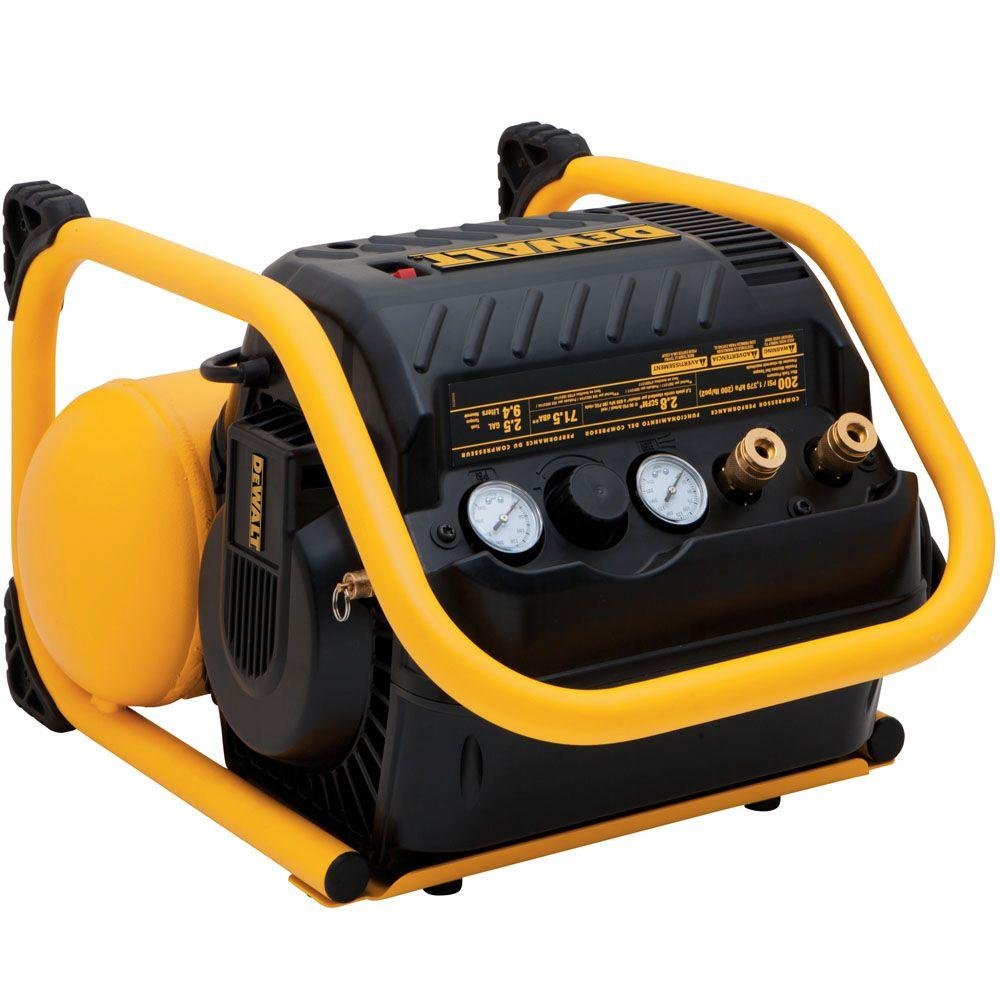
The DWFP55130 pushes 200 max PSI from a 2.5-gallon tank, giving it the highest storage pressure in its portable class. That extra ceiling means you get more usable shots per fill, especially when running multiple trim nailers on a job site. It delivers 3.0 SCFM at 90 PSI, which is notably higher than many similarly sized quiet compressors.
At 71.5 dBA, it’s not silent, but it’s significantly quieter than a traditional pancake compressor. The roll cage protects the control panel and motor, while the dual quick couplers let two users share the same unit without swapping fittings. The oil-free pump draws 12 amps, which is higher than average, so longer extension cords can cause tripping issues if not properly gauged.
Finish carpenters and remodeling pros will appreciate the fast recovery time and compact footprint. It stores vertically or horizontally, and the ball valve drain makes tank draining quick. For a single-user scenario firing brad or finish nailers, this compressor offers the best balance of pressure headroom and portability.
Why it’s great
- Highest max PSI (200) in this portable class for more stored shots
- Dual quick couplers enable simultaneous tool use
- Roll cage design protects key components on job sites
Good to know
- 12 amp draw may trip breakers with long or light-gauge cords
- Gauges are small and hard to read when stored flat
3. Rolair JC10 Plus

The JC10 Plus is built around a 1725 RPM motor and a cast-aluminum cylinder, a combination that delivers unusually quiet operation for a job-site compressor. Users consistently describe it as “whisper quiet” for indoor finish work. It fills its 2.5-gallon tank to 100 PSI in about 75 seconds and recovers fast enough to keep up with trim nailers without lag.
At 2.35 CFM at 90 PSI, it matches the needs of finish carpenters running 15- or 16-gauge nailers all day. The oil-less design removes routine maintenance, and the unloading valve plus rubber mounting feet cut vibration transfer to the floor — a real benefit in finished homes. The air filter housing protrudes slightly and can be knocked off, but this is a minor ergonomic issue rather than a performance flaw.
Professional trim carpenters and renovation crews who work inside occupied homes will appreciate the Rolair’s quiet, unobtrusive operation. It doesn’t have the high-pressure overhead of the DEWALT, but for steady, civilized trim work, it’s the most refined option on this list.
Why it’s great
- Exceptionally quiet operation ideal for indoor residential work
- Cast-aluminum cylinder and low-RPM motor reduce wear
- Unloading valve and rubber feet minimize vibration
Good to know
- Maxes out around 90 PSI so heavy framing tools may lag
- Air filter housing is exposed and can be knocked off
4. Metabo HPT EC28M

At only 59 decibels, the EC28M is the quietest compressor in this lineup — quieter than a normal conversation. Its 1-gallon tank and 25.2-pound weight make it genuinely portable, and the rubber carrying handle combined with a steel roll cage means it’s comfortable to carry and tough enough to survive drops on a job site.
The trade-off comes in usable air volume. This unit is designed for light-duty applications: airbrushing at 15-30 PSI, single nail guns, and tire top-offs. The 0.5 HP motor and small tank mean it cycles frequently under any sustained load, and the pump can get hot during longer sessions. It holds pressure for months between uses without leaking, which is a strong quality signal for occasional users.
Airbrush artists, hobby finishers, and anyone needing a near-silent compressor for small tasks will love this unit. It’s not a workshop workhorse, but for its niche, the combination of whisper-quiet operation and extreme portability is unmatched.
Why it’s great
- Near-silent 59 dB operation for noise-sensitive tasks
- Extremely lightweight at 25.2 lbs with roll cage protection
- Holds pressure for months with zero leakage
Good to know
- 1-gallon tank limits run time for continuous tools
- Pump can overheat with frequent cycling; needs cooldown breaks
5. VEVOR 4.8 Gallon

The VEVOR 4.8-gallon model uses a double-cylinder, double-tube intake design that builds pressure quickly, reaching full charge in under a minute. It delivers 2.2 CFM at 90 PSI and a 1.2 HP motor, which is enough for tire inflation, blow guns, and even light spray painting. The two included silencers bring noise down to roughly 70 dB, which is mid-range but still conversation-friendly.
The tank is constructed from Q235B structural steel with a three-layer rust-resistant coating, and the seamless welding adds real durability. It also features two large cooling fans and automatic overheat protection. Some buyers report the included instructions are poorly translated, and the unit is heavy at 34 pounds without a built-in hose or quick coupler in the box.
Home garage users who need a mid-volume compressor for tires, cleaning, and occasional nailing will find this a solid mid-range choice. It’s louder than the premium quiet units but offers more tank capacity at a lower entry point. Just budget for a good hose and coupler separately.
Why it’s great
- Fast pressure build with double-cylinder pump design
- Durable three-layer rust-resistant steel tank construction
- Dual silencers keep noise manageable at ~70 dB
Good to know
- Heavy for its size at 34 pounds
- No hose or quick coupler included in the package
6. Craftsman CMXECXA0200243

This 2-gallon hot-dog compressor is one of the lightest options available at just 18 pounds, with a top handle that makes it genuinely easy to carry one-handed. The 1/3 HP oil-free pump delivers 125 max PSI, and the 5.0 CFM rating is unusually high for this size — though real-world continuous draw is lower, it moves air quickly during bursts.
It’s ideal for inflating pool toys, car tires, and running a brad nailer for small projects. The maintenance-free pump is a plus for homeowners who don’t want to fuss with oil changes. However, this compressor is loud — reviewers consistently note it’s comparable to larger units — so hearing protection is a must. The included instructions are also notably sparse.
Budget-focused homeowners and RV users who need a portable, low-maintenance compressor for occasional tasks will appreciate the Craftsman’s light weight and simplicity. If you prioritize quiet operation or need sustained CFM for continuous tools, this isn’t the right fit.
Why it’s great
- Extremely lightweight at 18 pounds with easy-carry handle
- Oil-free pump requires zero routine maintenance
- Good burst CFM for quick inflation and small nailing jobs
Good to know
- Operates at loud volume requiring hearing protection
- Sparse instructions with tiny font; YouTube is needed for setup
7. Klutch 20-Gallon

The Klutch 20-gallon is the heaviest unit in this review at 90 pounds, and it’s built for a different class of work entirely. The 2.0 HP motor, splash oil-lubricated cast-iron twin-cylinder pump, and belt-driven design deliver 5.2 CFM and 175 max PSI with the durability needed for daily professional shop use. The thermal overload protection prevents overheating during extended tool operation.
Users report it handles impact wrenches, die grinders, and sanders without struggling, and the 20-gallon tank provides enough reserve to avoid constant cycling. The manual tank drain and oil sight gauge make maintenance straightforward, and the pump runs quieter than typical oil-free units of similar capacity due to the belt-driven design. One minor reported issue is a bent foot on some units, likely from factory assembly rather than shipping.
Professional mechanics, woodworkers, and serious DIY users who need a stationary compressor capable of running high-demand pneumatic tools should consider the Klutch. It’s not portable in any meaningful sense, but for a fixed workshop, it delivers impressive value and reliable performance.
Why it’s great
- Cast-iron twin-cylinder pump provides exceptional durability and lifespan
- Belt-driven design runs quieter than direct-drive oil-free units
- 5.2 CFM and 175 PSI handle professional-grade tools
Good to know
- Heavy 90-pound unit is not portable for job-site use
- Occasional factory assembly issues like bent feet need checking
FAQ
What size air compressor do I need for trim and finish nailing?
Is an oil-free or oil-lubricated compressor better for home use?
Why does my compressor lose pressure when not in use?
Can I use a quiet compressor for painting and spraying?
Final Thoughts: The Verdict
For most users, the best air compressor winner is the California Air Tools CAT-4610AC because it delivers the best combination of ultra-quiet 60 dB operation, rust-free aluminum tank, and reliable CFM for workshop tasks without breaking the bank. If you want the highest pressure headroom and dual-coupler convenience for job-site trim work, grab the DEWALT DWFP55130. And for silent, refined operation in occupied homes during finish carpentry, nothing beats the Rolair JC10 Plus.